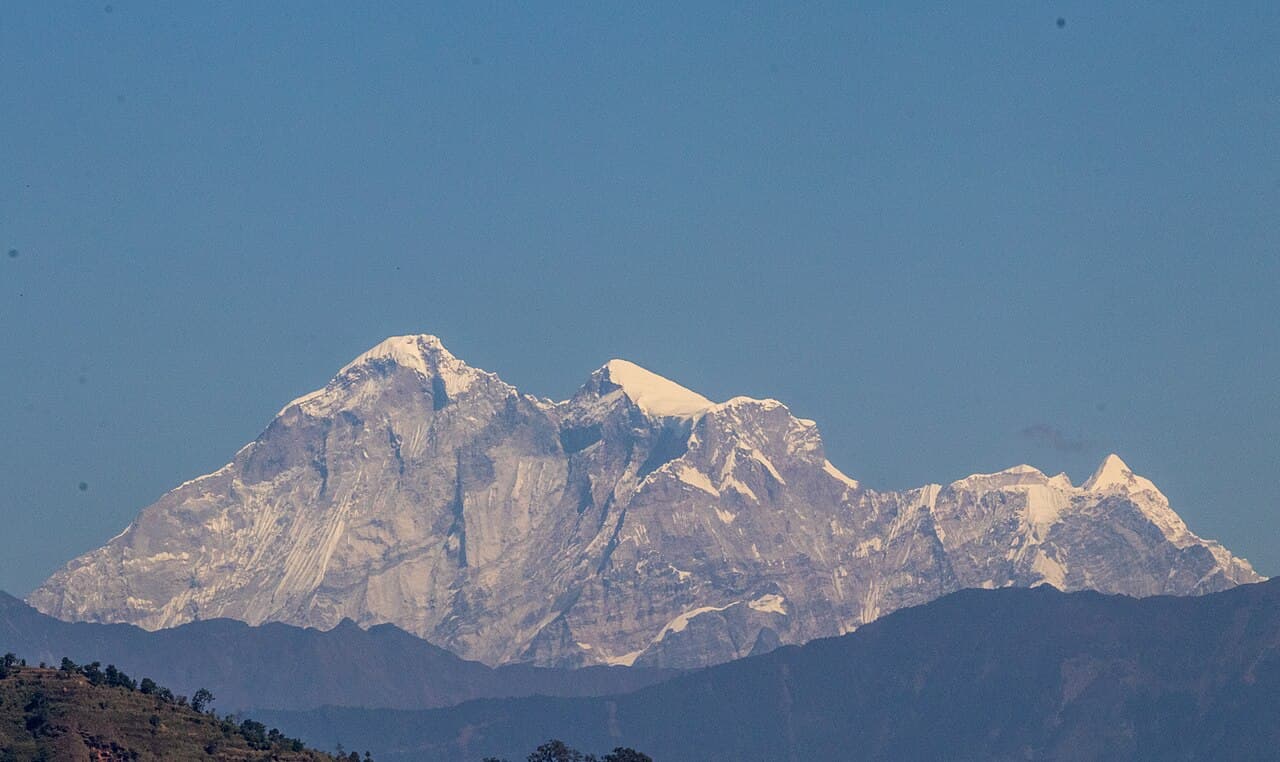
Rolwaling Himal, Bagmati Province
Gauri Sankar
also गौरीशंकर हिमाल · Gaurishankar · Gauri Shankar · Gaurisankar
7,134 m23,406 ft27.953°N 86.336°E
At a glance
- Elevation
- 7,134 m · 23,406 ft[1]
- Prominence
- 1,709 m[1]
- Range
- Rolwaling Himal[2]
- Region
- Dolakha District, Bagmati Province[2]
- Coordinates
- 27.9533° N, 86.3358° E[1]
Elevation is height above sea level; prominence is how far it rises above the lowest col connecting it to higher ground.
The mountain's story
Gaurishankar rises to 7,134 metres and is the second-highest peak of the Rolwaling Himal, on Nepal's border with Tibet in Dolakha District. Its name joins the Hindu goddess Gauri, a manifestation of Parvati, with her consort Shankar, a manifestation of Shiva, reflecting the sacred regard in which the people of Nepal hold it. The Sherpa people call it Jomo Tseringma.[2]
It has a quieter claim to everyday life, too: Nepal Standard Time is based on the meridian of this peak. In the nineteenth century the name was sometimes wrongly attached to Everest, a misattribution that lingered until about 1900.[3][2]
Little things worth knowing
Where it lives
Summit coordinates from Wikidata; hollow dots are viewpoints from which this peak is documented as visible.
Look closer
Culture & meaning
- Names and documented meaning
Gauri (Parvati) and Shankar (Shiva) give the mountain its Nepali name; Sherpa communities call it Jomo Tseringma.[2]
If you want to visit
Places from which Gauri Sankar is documented as visible:
- Dhulikhel[4]
Permits, fees and access rules change. Check current requirements with the Nepal Tourism Board before you travel. We don't list routes or logistics we can't keep current.
Sources & further reading
4 sources
- [1]Wikidata item Q1496289, Wikidata, retrieved 2026-10-23 · accessed 2026-10-23
- [2]Gaurishankar, Wikipedia · accessed 2026-10-23
- [3]Mount Everest, Wikipedia · accessed 2026-10-23
- [4]Dhulikhel, Wikipedia · accessed 2026-10-23
Structured values (elevation, coordinates, prominence) come from Wikidata, which aggregates survey sources. Wikipedia articles are used as secondary references; we prefer primary survey and expedition records as we add them. Last verified 2026-10-23.