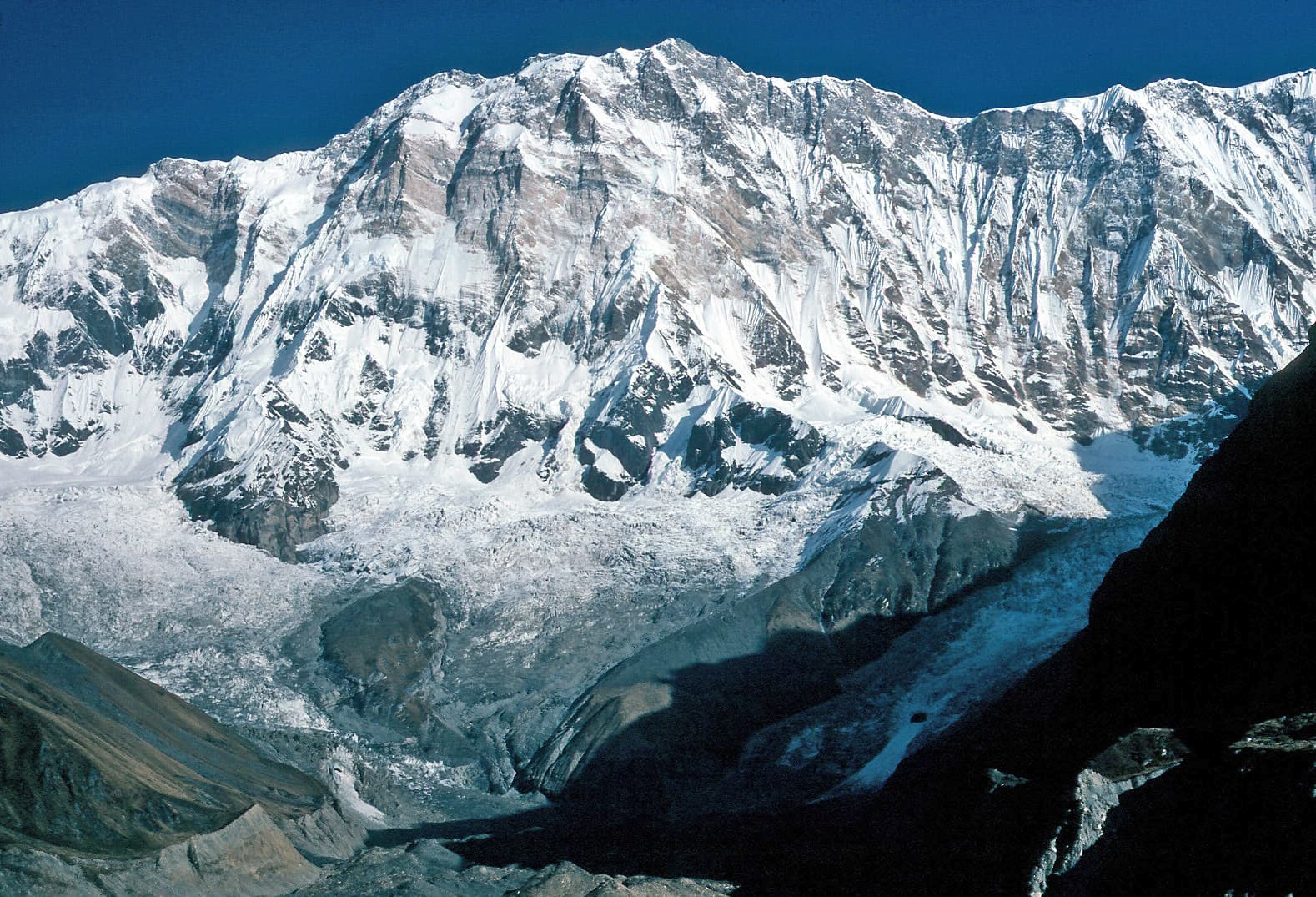
Annapurna Himal, Gandaki Province
Annapurna
also अन्नपूर्ण हिमाल · Annapurna · Annapurna I Main
8,091 m26,545 ft28.596°N 83.820°E
At a glance
- Elevation
- 8,091 m · 26,545 ft[1]
- Prominence
- 2,984 m[1]
- Range
- Annapurna Himal[2]
- Region
- Gandaki Province[2]
- Coordinates
- 28.5958° N, 83.8200° E[1]
- Nearby
- Pokhara (regional gateway)[2]
Elevation is height above sea level; prominence is how far it rises above the lowest col connecting it to higher ground.
The mountain's story
Annapurna I rises to 8,091 metres in the Annapurna range of Gandaki Province, north-central Nepal, and is the tenth-highest mountain in the world. It takes its name from the Hindu goddess of food and nourishment, who is said to reside there; in Sanskrit, anna means food and purna means filled.[2]
In 1950 a French expedition led by Maurice Herzog reached the summit by the north face, making Annapurna the first eight-thousander ever climbed. It remains known for the danger of its ascent, above all its 3,000-metre south face. The massif and its surroundings are protected within the Annapurna Conservation Area, the first and largest conservation area in Nepal. The range lies within about 25–55 kilometres of Pokhara, the region's gateway city.[3][2]
Little things worth knowing
- 1
First of fourteen
Herzog's 1950 French expedition made Annapurna the first eight-thousander to be climbed.[2]
- 2
Largest protected area
The Annapurna Conservation Area covers 7,629 km² and is Nepal's first and largest conservation area.[2]
- 3
Steep reputation
For decades Annapurna I had the highest fatality-to-summit rate of the principal eight-thousanders.[2]
Rivers from this mountain
Water that begins in its snow and ice, or drains the range around it.
Marshyangdiमर्स्याङ्दी नदी
Drains the range around it
Begins north-west of the Annapurna massif near Manang, where the Khangsar and Jharsang streams meet.[6]
Where it lives
Summit coordinates from Wikidata; hollow dots are viewpoints from which this peak is documented as visible.
Look closer
Culture & meaning
- Names and documented meaning
The mountain is named for Annapurna, the Hindu goddess of food and nourishment, who is said to reside there.[2]
If you want to visit
Places from which Annapurna is documented as visible:
Permits, fees and access rules change. Check current requirements with the Nepal Tourism Board before you travel. We don't list routes or logistics we can't keep current.
Sources & further reading
9 sources
- [1]Wikidata item Q16466024, Wikidata, retrieved 2026-10-23 · accessed 2026-10-23
- [2]Annapurna, Wikipedia · accessed 2026-10-23
- [3]Pokhara, Wikipedia · accessed 2026-10-23
- [4]Modi River, Wikipedia · accessed 2026-10-23
- [5]Seti Gandaki River, Wikipedia · accessed 2026-10-23
- [6]Marshyangdi River, Wikipedia · accessed 2026-10-23
- [7]Sarangkot, Wikipedia · accessed 2026-10-23
- [8]